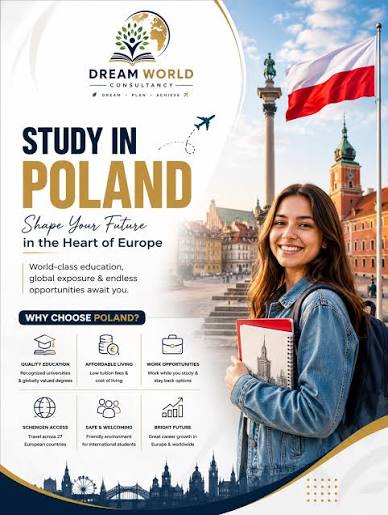
Poland has become an increasingly important destination for students looking for quality higher education in Europe. With universities offering a wide range of academic programs, modern facilities, and international study opportunities, the country provides an attractive environment for both local and international students.
The development of higher education in Poland is also connected with changes in technology, employment, and international cooperation. Universities are adapting their programs to meet the needs of students and the modern workforce.
Growing Opportunities for International Students
One of the important developments in Polish higher education is the growing number of opportunities available to international students. Universities in cities such as Warsaw, Kraków, Wrocław, Poznań, and Gdańsk offer programs in areas including business, engineering, computer science, medicine, economics, and social sciences.
Many institutions also provide programs taught in English. This makes it easier for students from different countries to consider Poland as an option for higher education without needing to study entirely in the Polish language.
International students can also benefit from Poland’s location in Europe. Studying in the country provides opportunities to experience a different culture while building connections with students and professionals from various backgrounds.
Modern University Education
Modern universities are no longer focused only on traditional classroom teaching. Technology has become an important part of the learning process, and Polish educational institutions are adopting digital tools to support students and teachers.
Online learning platforms, digital libraries, virtual classrooms, and electronic academic resources allow students to access information more easily. These tools can also make communication between students and teachers more efficient.
Technology can be particularly useful for students who need flexible learning options. Digital resources allow them to review academic materials, complete assignments, and participate in educational activities outside traditional classroom hours.
Practical Skills and Career Development
Academic knowledge is important, but students also need practical skills to succeed after graduation. Polish universities are increasingly connecting education with professional development through internships, workshops, research projects, and cooperation with companies.
For example, students studying engineering or computer science may have opportunities to work on practical projects involving software, automation, data analysis, or other technologies. Business students may participate in entrepreneurship programs or projects involving real companies.
These experiences can help students understand how theoretical concepts are applied in professional environments. They can also help graduates develop communication, teamwork, problem-solving, and project-management skills.
The Role of Research
Research is another important part of higher education in Poland. Universities provide environments where academics and students can investigate new ideas and develop solutions to complex problems.
Research can cover many areas, including medicine, environmental science, engineering, information technology, economics, and social sciences. Collaboration between universities and research organizations can provide students with opportunities to participate in academic projects and gain valuable research experience.
University research can also contribute to innovation by creating new technologies, improving existing processes, and addressing challenges faced by businesses and communities.
Supporting Student Development
Higher education is not only about academic qualifications. University life can also help students develop personal and professional skills that remain useful throughout their careers.
Participation in student organizations, academic clubs, conferences, volunteer activities, and group projects can help students build confidence and communication abilities. These activities also provide opportunities to meet people with similar interests.
Career support services can further assist students with preparing CVs, developing interview skills, finding internships, and understanding employment opportunities. Such support can make the transition from university to professional life easier.
Education and the Changing Job Market
The job market continues to change as businesses adopt new technologies and working methods. This means universities need to prepare students for both current and future employment opportunities.
Fields such as information technology, cybersecurity, engineering, renewable energy, healthcare, and data analysis are becoming increasingly important. At the same time, employers continue to value transferable skills such as critical thinking, communication, adaptability, and teamwork.
Universities that combine academic education with practical experience can help students become more prepared for these changing requirements.
Poland as an Educational Destination
Poland offers a combination of established academic institutions, diverse study programs, cultural experiences, and international opportunities. Its universities serve students with different academic interests, from traditional disciplines to modern technology-focused programs.
For international students, studying in Poland can provide an opportunity to gain an academic qualification while experiencing life in a European country. The presence of students from different countries also creates a multicultural learning environment.
Conclusion
The future of higher education in Poland will continue to be shaped by technology, international cooperation, research, and changing employment requirements. Universities have an important responsibility to provide students with strong academic foundations while also helping them develop practical and professional skills.
Leave a Reply