School quality plays a major role in student achievement, teacher effectiveness, and family confidence. However, how can parents and education professionals determine whether a school meets established educational standards? One important way is through accreditation. Understanding the school accreditation process explained in this guide can help school leaders, teachers, parents, and education professionals recognize how external evaluations support educational quality and continuous improvement.
School accreditation is more than a certificate or a formal recognition. It involves reviewing a school’s educational practices, leadership, resources, student support systems, and commitment to improvement. Although requirements differ between countries and accrediting organizations, the process generally encourages schools to evaluate their performance, identify weaknesses, and demonstrate how they meet recognized standards.
What Is School Accreditation?
School accreditation is a formal evaluation process in which an authorized or recognized accrediting organization assesses whether a school meets established quality standards. Depending on the education system, accreditation may be voluntary, required for particular purposes, or connected to other forms of educational oversight.
The evaluation may examine several areas, including:
- Curriculum quality and instructional practices
- Teacher qualifications and professional development
- Student learning outcomes and academic progress
- School leadership and governance
- Student safety, wellbeing, and support services
- Facilities, learning materials, and educational technology
- Financial management and institutional planning
- Family engagement and community relationships
The purpose is to determine how effectively a school fulfills its educational mission and whether it has reliable systems for maintaining and improving quality.
Accreditation requirements are not identical worldwide. Some countries rely primarily on government inspection or national quality assurance systems, while others use independent accrediting organizations. Schools should therefore identify the standards and legal requirements that apply to their location and type of institution.
Why Is School Accreditation Important?
Accreditation can provide a structured way to evaluate school performance and communicate findings to relevant stakeholders. Its value depends on the credibility of the accrediting organization, the standards it applies, and the school’s response to the evaluation.
1. Supports Educational Quality
Accreditation encourages schools to compare their practices against established expectations. Reviewing lesson planning, assessment methods, curriculum alignment, and student outcomes can help educators identify areas where teaching and learning need improvement.
Rather than relying on assumptions, schools can use documented evidence to determine whether their educational approaches are effective.
2. Encourages Accountability
Schools serve students, families, and communities. Accreditation can help them demonstrate how they manage resources, monitor academic progress, support students, and address identified weaknesses.
A credible review process also makes responsibilities clearer by requiring school leaders to explain decisions and document progress.
3. Builds Confidence Among Families
Parents often consider educational quality, student safety, teacher expertise, and available support when choosing a school. Accreditation may provide additional information about whether an institution has undergone an external review.
However, families should not assume that every accreditation label represents the same standards. They should verify the accreditor’s credibility, the school’s current status, and the scope of the evaluation.
4. Promotes Continuous Improvement
Accreditation is most useful when schools treat it as an ongoing improvement process rather than a one-time achievement. Evaluation findings can inform teacher training, curriculum development, student support, and long-term planning.
Schools can use these findings to establish measurable goals and monitor whether changes produce meaningful results.
5. Strengthens School Planning
The accreditation process often requires school leaders to review policies, responsibilities, budgets, and performance indicators. This work can reveal gaps in planning and encourage better coordination between administrators, teachers, and support staff.
How Does the School Accreditation Process Work?
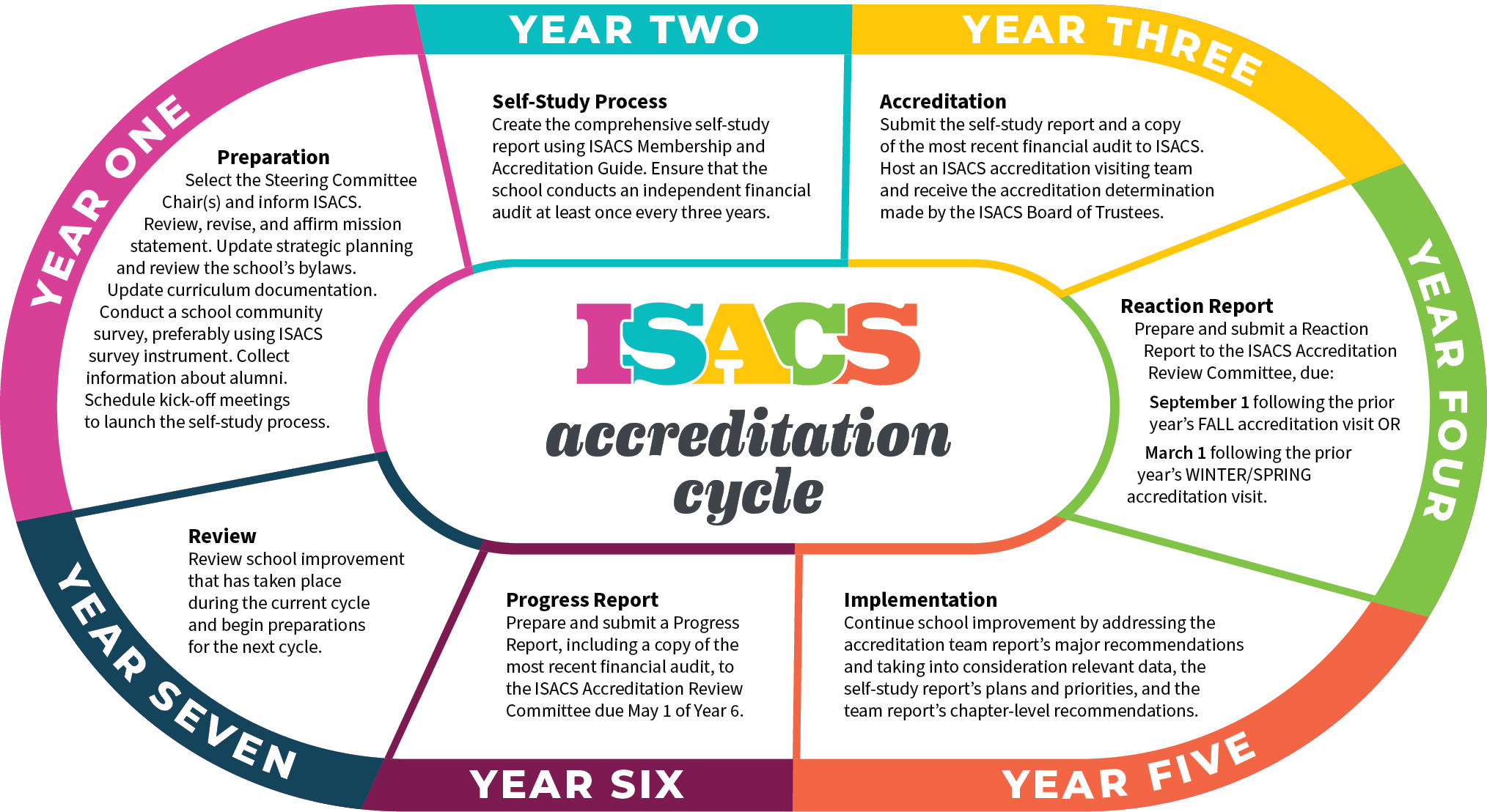
Although each accrediting organization follows its own procedures, the school accreditation process commonly includes several stages. Understanding these stages helps schools prepare effectively and avoid treating accreditation as a last-minute paperwork exercise.
Step 1: Identify the Appropriate Accrediting Organization
The first step is to determine which accreditation or quality assurance body is suitable for the school.
School leaders should investigate:
- Whether the organization is recognized or authorized by the relevant education authority
- Which types of schools it evaluates
- What standards and eligibility requirements it uses
- How long the accreditation cycle lasts
- What fees, documentation, and evaluation activities are required
- Whether the accreditation is accepted for the school’s intended purpose
This research is essential because an organization offering accreditation services is not necessarily recognized by the relevant authorities. Schools should verify the accreditor independently before paying fees or beginning an application.
Step 2: Review Eligibility Requirements
After identifying a suitable organization, the school should confirm that it meets the eligibility criteria.
Requirements may include legal authorization to operate, an established curriculum, qualified staff, appropriate facilities, documented policies, and sufficient operating history. Some organizations may require schools to complete preliminary assessments before submitting a full application.
School leaders should create a checklist of all requirements and assign responsibility for each item. Any gaps should be documented, along with a realistic plan for addressing them.
Step 3: Conduct a School Self-Study
A self-study is a structured internal review of the school’s performance against the accreditor’s standards. It allows school staff to evaluate current practices, identify strengths, and determine where improvement is necessary.
A comprehensive self-study may examine:
- Student achievement and learning progress
- Curriculum design and classroom instruction
- Teacher qualifications and staff development
- Leadership, governance, and decision-making
- School culture, inclusion, and student wellbeing
- Safeguarding and emergency procedures
- Family communication and community involvement
- Resource allocation and improvement planning
The school should collect evidence instead of relying solely on general statements. Useful evidence may include assessment results, curriculum documents, staff qualifications, meeting records, student support policies, and feedback from families.
The self-study should present an honest picture of the institution. Identifying a weakness is not automatically a failure; it can demonstrate that the school understands its responsibilities and is prepared to improve.
Step 4: Prepare and Submit the Accreditation Application
Once the school has reviewed its eligibility and gathered the necessary evidence, it can prepare the formal application.
The application may include institutional information, governance documents, curriculum details, staffing records, policies, self-study findings, and supporting evidence. Some accreditors also require application fees, preliminary reports, or specific forms.
Before submission, school leaders should check that documents are complete, consistent, current, and clearly organized. Information in the application should match the evidence available for review.
A designated accreditation coordinator can help maintain the document checklist, track deadlines, and communicate with the accrediting organization.
Step 5: Complete the External Evaluation
An external evaluation allows qualified reviewers to examine the school’s claims and assess its performance against the required standards.
Depending on the accreditation system, the evaluation may include an on-site visit, a remote review, interviews, document analysis, classroom observations, or a combination of these methods.
Reviewers may speak with school leaders, teachers, students, parents, and support staff. They may also examine how the school uses assessment results, manages student safety, supports diverse learning needs, and monitors instructional quality.
The aim is not simply to check whether policies exist. Reviewers may also consider whether those policies are implemented consistently and whether they achieve their intended purpose.
Schools should prepare staff to explain their work clearly and honestly. Evidence should be readily available, and responses should reflect actual practice rather than what the school believes reviewers want to hear.
Step 6: Receive the Accreditation Decision
After the evaluation, the accrediting organization reviews the evidence and determines the outcome under its own rules.
Possible outcomes vary but may include:
- Accreditation granted: The school meets the applicable requirements.
- Accreditation with conditions: The school must address specified issues within a defined period.
- Deferred or pending decision: Further evidence or review may be required.
- Accreditation denied: The school has not met the required standards.
The exact terminology differs by accreditor. Schools should carefully review the decision letter, including the accreditation scope, validity period, conditions, and any appeal procedures.
If improvements are required, leaders should turn the findings into a practical action plan with assigned responsibilities and deadlines.
Step 7: Maintain Accreditation Through Ongoing Improvement
Receiving accreditation does not mean a school can stop evaluating its performance. Many systems require periodic reporting, follow-up reviews, renewal applications, or a new comprehensive evaluation after a specified period.
Schools should maintain accurate records, monitor student progress, review policies regularly, and document improvements. Significant changes in leadership, curriculum, ownership, or educational programs may also need to be reported, depending on the accreditor’s requirements.
A consistent improvement cycle helps schools remain prepared for future reviews while keeping attention on students’ educational needs.
What Standards Do Accrediting Organizations Evaluate?
The standards used in school accreditation depend on the organization and the education system. Nevertheless, several areas frequently form part of a school quality review.
Curriculum and Teaching Quality
Reviewers may consider whether the curriculum is coherent, age-appropriate, aligned with applicable requirements, and supported by effective teaching strategies.
Schools should be able to show how learning objectives guide instruction and how teachers adjust their approaches when students need additional support.
Student Learning Outcomes
Student achievement data can help schools understand whether learners are making expected progress. Evidence may include classroom assessments, standardized results where applicable, attendance patterns, course completion, and other relevant indicators.
Data should be interpreted carefully. Results can be influenced by many factors, so schools should consider context rather than relying on a single measure.
Teacher Qualifications and Professional Development
Qualified, supported teachers are central to educational quality. Accreditation reviews may examine hiring procedures, required credentials, staff evaluations, mentoring, and opportunities for professional learning.
Schools should show how professional development connects to classroom needs and school improvement goals.
Leadership and Governance
Effective school leadership requires clear responsibilities, transparent decision-making, appropriate oversight, and realistic planning.
Reviewers may examine how school leaders establish priorities, communicate expectations, monitor progress, and involve relevant stakeholders in important decisions.
Student Safety and Wellbeing
A quality review may consider safeguarding procedures, anti-bullying policies, emergency plans, accessibility, counselling, and support for students with different learning needs.
Schools should demonstrate that policies are communicated, staff understand their responsibilities, and procedures are implemented consistently.
Resources and Learning Environment
Facilities, instructional materials, technology, and financial resources can affect students’ learning experiences. Accrediting organizations may evaluate whether the school has appropriate resources and manages them responsibly.
The focus is generally on whether available resources support the school’s mission and educational objectives, rather than on appearance alone.
What Documents Should Schools Prepare for Accreditation?
Good documentation helps schools demonstrate how their policies and practices work in reality. The exact list should always come from the relevant accrediting organization.
Commonly requested materials may include:
- School mission, vision, and strategic plan
- Curriculum maps, syllabi, and lesson-planning examples
- Teacher credentials and professional development records
- Student assessment and progress reports
- Attendance and retention data, where relevant
- School governance and organizational charts
- Student safeguarding and wellbeing policies
- Health, safety, and emergency procedures
- Staff and family feedback summaries
- Budgeting and resource management records
- Previous evaluation reports and improvement plans
Schools should protect confidential student and employee information throughout the process. Where reviewers need access to sensitive records, the school should follow applicable privacy laws and the accreditor’s secure documentation procedures.
An organized evidence repository can make the review easier. Documents should be clearly named, dated, assigned to responsible staff members, and updated when policies or procedures change.
Common Challenges in the School Accreditation Process
Accreditation can require considerable time and coordination. Recognizing common difficulties early can help schools manage the process more effectively.
Incomplete Documentation
Missing records, outdated policies, or inconsistent information can delay the review and make it harder to demonstrate compliance.
How to address it: Conduct an early document audit, use a shared checklist, and assign a responsible person to each requirement.
Limited Staff Time
Teachers and administrators already have substantial daily responsibilities. Accreditation tasks can become overwhelming if they are added without a clear schedule.
How to address it: Create a realistic timeline, distribute responsibilities fairly, and integrate evidence collection into existing school improvement activities.
Resistance to Evaluation
Some staff members may see accreditation as criticism or unnecessary administrative work.
How to address it: Explain the purpose of the process, invite staff participation, and use findings to support practical improvements rather than blame individuals.
Weak Use of Data
Schools may collect large amounts of information without using it to guide decisions.
How to address it: Choose relevant indicators, review trends regularly, and connect findings to specific actions. For example, attendance patterns may prompt a review of family communication or student support services.
Treating Accreditation as a One-Time Event
A school may prepare extensively for a review but fail to maintain its improvements afterward.
How to address it: Assign ownership of improvement goals, set review dates, and include progress checks in regular leadership and staff meetings.
How Can Schools Prepare for Accreditation Successfully?
A successful accreditation process begins well before the external evaluation. The following practices can help school leaders establish a manageable and effective approach.
Start early. Review eligibility requirements and create a timeline that includes the self-study, application, evidence collection, external review, and follow-up activities.
Involve the school community. Include administrators, teachers, support staff, and relevant parent or student representatives where appropriate. Broader participation can reveal issues that leadership alone might overlook.
Use evidence consistently. Connect statements about school quality to records, observations, assessment results, and documented practices.
Be honest about weaknesses. A credible improvement plan acknowledges gaps and explains how the school intends to address them.
Communicate clearly. Staff should understand the purpose of accreditation, what their responsibilities are, and where they can find the necessary documents.
Monitor progress. Use measurable goals, assigned responsibilities, and regular check-ins to ensure that improvements continue after the review.
These practices help make accreditation part of the school’s everyday quality assurance system instead of a temporary project.
What Is the Difference Between School Accreditation and School Inspection?
School accreditation and school inspection can both evaluate educational quality, but they are not necessarily the same.
School accreditation often involves a structured review against standards established by an accrediting organization. It may emphasize institutional self-evaluation, external peer review, and continuous improvement.
School inspection is commonly conducted by a government authority or designated inspectorate to assess whether a school meets legal, regulatory, or educational requirements. Depending on the jurisdiction, inspections may be mandatory and may lead to formal regulatory action.
The two processes can overlap, and terminology varies across countries. Accreditation should not automatically be treated as a replacement for government authorization, licensing, inspection, or other legal obligations.
School leaders should understand which requirements apply to their institution and maintain compliance with each relevant system.
How Can Parents Check a School’s Accreditation Status?
Parents can use accreditation information as one part of their school research. Before relying on an accreditation claim, they should consider the following questions:
- Which organization accredited the school?
- Is the organization recognized or authorized by a relevant education authority?
- Does the accreditation apply to the entire school or only to a specific program?
- Is the school’s status current, and when is the next review due?
- Are any conditions, limitations, or outstanding requirements publicly disclosed?
- Does the accreditation serve the family’s educational goals, such as transfer, further study, or professional eligibility?
Parents should verify information through the accrediting organization’s official directory or the appropriate government education authority whenever possible.
They should also consider other factors, including teaching quality, student support, school culture, curriculum, safety, and the school’s suitability for the individual learner. Accreditation can offer useful information, but it is not a complete measure of every student’s experience.
Frequently Asked Questions About School Accreditation
How long does the school accreditation process take?
The timeline depends on the accrediting organization, the school’s readiness, and the complexity of the review. Preparation may take months or longer, particularly when extensive self-evaluation or policy improvements are needed. Schools should obtain a timeline directly from their chosen accreditor.
Is school accreditation mandatory?
It depends on the country, education system, school type, and intended purpose. Some systems require government authorization or other formal quality assurance, while independent accreditation may be voluntary. Schools must verify the rules that apply to them.
Does accreditation guarantee high student achievement?
No. Accreditation indicates that a school has been evaluated against particular standards within a defined scope. It cannot guarantee a specific student’s academic results or ensure that every aspect of school performance is excellent.
Can a school lose its accreditation?
Yes. Depending on the accreditor’s rules, a school may lose accreditation if it fails to maintain required standards, does not meet conditions, or no longer satisfies eligibility requirements. Some organizations may provide an opportunity to address deficiencies or appeal a decision.
Is accreditation the same as certification?
No. Accreditation generally evaluates an institution or educational program against established standards. Certification usually confirms that an individual, organization, or product meets specified requirements. The exact definitions can vary by field and jurisdiction.
What should a school do if accreditation is denied?
School leaders should carefully review the decision, identify unmet standards, and understand any appeal or reapplication options. They can then create a corrective action plan, gather additional evidence, and seek clarification from the accrediting organization.
Conclusion
Understanding the school accreditation process explained in this guide helps educators, school leaders, and families see how external evaluation can contribute to educational quality and accountability. The process commonly involves selecting an appropriate accreditor, confirming eligibility, completing a self-study, submitting evidence, undergoing an external review, and responding to the final decision.
However, the greatest value of accreditation comes from what schools do with the findings. By strengthening teaching practices, supporting student wellbeing, improving leadership, and monitoring progress over time, schools can build a stronger foundation for continuous improvement.
For school administrators, the practical next step is to identify the relevant accrediting or quality assurance organization and review its official standards before beginning preparations. For parents, verifying an institution’s current status and understanding the scope of its accreditation can support more informed educational decisions.
Leave a Reply