Classroom seating arrangements play an important role in shaping how students communicate, share ideas, and work together. The way desks and chairs are organized can influence whether learners interact easily with classmates, participate in discussions, and feel comfortable contributing to group activities. For teachers, choosing the right classroom layout is therefore an important part of creating an effective learning environment.
Traditional rows, small-group tables, U-shaped seating, and flexible classroom layouts each offer different opportunities for learning. Some arrangements support independent concentration, while others make discussion and teamwork more convenient. The most effective option depends on the lesson objectives, students’ needs, classroom size, and teaching approach.
Understanding classroom seating arrangements for learning helps educators design spaces that encourage collaboration without sacrificing focus, accessibility, or individual learning time. With thoughtful planning, teachers can make better use of available classroom space and help students develop communication, problem-solving, and teamwork skills.
Why Classroom Seating Arrangements Matter
A classroom is more than a place where students listen to lessons. It is a social learning environment where students ask questions, exchange ideas, practice skills, and develop relationships. The physical arrangement of desks influences how easily these activities can take place.
When students can see one another, reach shared materials, and communicate comfortably, collaborative activities may become easier to organize. In contrast, layouts that make interaction difficult can create unnecessary barriers during discussions or group projects.
Seating arrangements can influence several aspects of classroom learning:
- Communication: Students can exchange ideas more easily when seating supports face-to-face interaction.
- Participation: A well-planned layout can make it easier for students to contribute to discussions.
- Teamwork: Shared workspaces help students divide responsibilities and complete tasks together.
- Teacher interaction: Classroom layouts affect how easily teachers can reach students and provide guidance.
- Attention: The right arrangement can reduce some distractions and support focused learning.
- Inclusion: Accessible layouts can help more students participate comfortably in classroom activities.
However, no seating arrangement guarantees better collaboration or higher academic performance. Teachers should consider the purpose of each lesson and observe how students respond to different layouts.
Common Classroom Seating Arrangements for Learning
Different classroom layouts support different instructional goals. Understanding their strengths and limitations helps teachers select an arrangement that matches the activity.
1. Traditional Row Seating
<AsyncImage query=”school classroom desks arranged in traditional straight rows facing whiteboard” aspectRatio=”16:9″ width=”100%” />
Traditional row seating places desks in lines facing the front of the classroom. This arrangement is commonly used for direct instruction, individual assignments, tests, and activities that require sustained attention.
Rows make it easier for students to focus on the teacher or instructional materials. They can also help teachers monitor individual work and maintain clear walking paths when desks are spaced appropriately.
However, rows may limit face-to-face interaction between classmates. Students often need to turn around or move their chairs to work together, which can interrupt the flow of a collaborative activity.
Best use: Individual assignments, assessments, demonstrations, and lessons that require students to concentrate on a shared focal point.
Teachers can make row seating more flexible by allowing students to turn toward a partner for short discussions or temporarily move desks into groups when needed.
2. Small-Group or Cluster Seating
<AsyncImage query=”elementary school classroom desks arranged in small clusters of four students for teamwork” aspectRatio=”16:9″ width=”100%” />
Cluster seating brings small groups of desks together, often accommodating three to six students. This layout is particularly useful for cooperative learning, peer discussion, project work, and shared problem-solving activities.
Students can exchange ideas without repeatedly changing their positions. They can also share resources, compare answers, and divide responsibilities more easily.
Cluster seating can create challenges if students become distracted by nearby conversations or if one student dominates the group. Teachers may need to establish clear expectations and assign responsibilities to ensure that everyone contributes.
Best use: Group projects, peer tutoring, collaborative research, science activities, and problem-solving tasks.
To improve this arrangement, teachers can assign rotating roles such as discussion leader, note-taker, materials manager, and presenter. These roles help students practice different teamwork skills and make individual contributions more visible.
3. U-Shaped or Horseshoe Seating
<AsyncImage query=”classroom desks arranged in U shape horseshoe layout with open center and teacher at front” aspectRatio=”16:9″ width=”100%” />
U-shaped seating positions desks around an open central space. Most students can see the teacher and many of their classmates, making this arrangement suitable for discussions, demonstrations, presentations, and interactive lessons.
The layout encourages students to respond to one another rather than directing every comment toward the teacher. It can also help teachers move through the classroom and notice when students need support.
However, a U-shaped arrangement may not fit comfortably in a small classroom or a room with many students. Some students may also be farther from the main teaching area than others.
Best use: Whole-class discussions, debates, presentations, question-and-answer sessions, and activities that benefit from shared visibility.
Teachers should ensure that every student has a clear view of displays and classmates, and that the arrangement leaves enough space for accessible movement.
4. Circle Seating
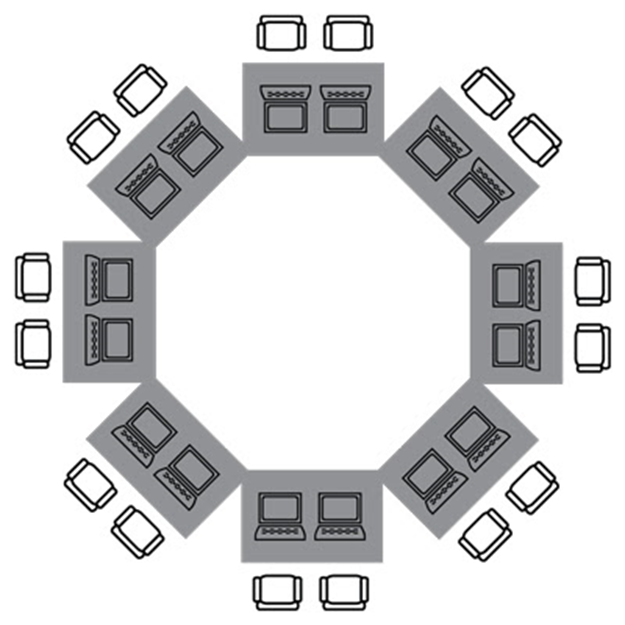
Circle seating places chairs or desks in a circular formation, allowing students to face one another during discussions. It can create a more conversational atmosphere and encourage students to listen carefully to different viewpoints.
This layout works particularly well when the purpose of the lesson is to exchange perspectives, reflect on an issue, or discuss a shared reading.
Circle seating is less practical for activities requiring extensive written work, individual computer use, or large amounts of equipment. Some students may also feel uncomfortable speaking in front of the whole class.
Best use: Class meetings, reflective discussions, literature circles, social-emotional learning activities, and student-led conversations.
Teachers can make circle discussions more inclusive by providing thinking time, using structured speaking turns, and allowing students to contribute in different ways.
5. Flexible Seating Arrangements
Flexible seating allows teachers to adjust the classroom layout according to the learning activity. Desks may be arranged in rows for independent work, clusters for teamwork, and a semicircle for discussion.
The main advantage is adaptability. Instead of expecting one layout to support every learning goal, teachers can create a classroom that changes with the lesson.
Flexible seating does not necessarily require expensive furniture. In many classrooms, movable desks and chairs are enough to create several useful arrangements.
However, frequent rearrangement can consume lesson time if students do not understand the process. Teachers should establish simple routines for moving furniture safely and returning it to its original position.
Best use: Classrooms that combine independent learning, collaborative projects, teacher-led instruction, and student presentations.
How Seating Arrangements Encourage Student Collaboration
Effective collaboration requires more than placing students next to one another. Students need opportunities to communicate, share responsibilities, listen respectfully, and work toward a common goal. Classroom design can support these behaviors when it is combined with clear teaching strategies.
Improving Face-to-Face Communication
Students often need to explain their reasoning, ask questions, and respond to their classmates during collaborative work. Seating that allows students to face one another can make these exchanges more natural.
For example, during a mathematics activity, students sitting in a small cluster can compare different ways of solving a problem. Each learner can explain a method, listen to alternatives, and identify mistakes through discussion.
Teachers should also consider the classroom’s noise level. If groups are too close together, conversations may overlap and make it difficult for students to hear one another.
Encouraging Equal Participation
Some students naturally speak more often than others. A well-planned layout, combined with structured activities, can help teachers create more opportunities for quieter students to contribute.
Teachers can use strategies such as round-robin sharing, partner discussions, and written idea generation before group conversations begin.
Seating should not be used as the only solution to participation differences. Clear instructions, supportive relationships, and classroom norms are equally important.
Supporting Peer Learning
Peer learning allows students to explain concepts to one another, compare ideas, and practice skills collaboratively. Seating arrangements that provide access to shared materials and comfortable discussion can make these activities easier to manage.
For instance, students working on a science investigation can gather around a shared workspace to record observations and discuss results.
Teachers should ensure that each student remains actively involved rather than allowing one learner to complete the entire task. Individual accountability makes collaborative learning more meaningful.
Building Positive Classroom Relationships
Working alongside different classmates can help students become more familiar with one another and develop communication skills. Research on classroom seating has found that physical proximity can influence friendship formation, although relationships are also shaped by personal preferences, classroom culture, and other factors.
Teachers can rotate group membership thoughtfully so that students have opportunities to work with different peers while maintaining a sense of safety and belonging.
The goal is not to force friendships but to create respectful opportunities for students to cooperate with a wider range of classmates.
Matching Classroom Seating to the Learning Activity
The best classroom seating arrangement depends on what students are expected to accomplish. A layout that works well for a discussion may be less suitable for a test or an individual reading task.
Teachers can use the following examples when planning lessons:
| Learning activity | Suggested arrangement | Main benefit |
|---|---|---|
| Individual reading or writing | Rows or individual desks | Supports concentration |
| Partner discussions | Pairs or neighboring desks | Makes quick exchanges easier |
| Group projects | Small desk clusters | Supports shared tasks |
| Class debates | U-shaped seating | Improves visibility and discussion |
| Student presentations | Semicircle or U-shape | Helps classmates see the presenter |
| Practical activities | Flexible workstations | Organizes materials and movement |
| Reflection or class meetings | Circle seating | Encourages shared conversation |
These suggestions are starting points rather than strict rules. Teachers should adapt them to the age of students, the complexity of the activity, available space, and accessibility requirements.
A useful approach is to plan the learning objective first and choose the seating arrangement afterward.
Practical Strategies for Teachers
Teachers can improve the value of classroom seating by connecting room organization with clear instructional routines.
1. Start With the Lesson Objective
Before moving desks, identify what students should learn or produce. If the task requires independent concentration, rows may be appropriate. If students need to compare ideas or create a shared product, small groups may work better.
This simple decision prevents classroom arrangement from becoming a routine that is disconnected from the learning goal.
2. Establish Clear Group Roles
Collaborative seating works best when students understand their responsibilities. Assigning roles can help prevent confusion and reduce the chance that one student completes most of the work.
Roles should change regularly so students can practice different skills, including organizing information, explaining ideas, managing resources, and presenting results.
3. Create Clear Movement Paths
Students and teachers need to move safely around the classroom. Desks should not block entrances, emergency routes, accessible pathways, or access to essential learning materials.
Teachers should check that students can reach their seats comfortably and that the layout accommodates mobility devices and other accessibility needs.
4. Minimize Unnecessary Distractions
Group seating can make communication easier, but it may also increase off-task conversation during activities that require concentration.
Teachers can reduce distractions by creating enough space between groups, giving specific time limits, using clear task instructions, and establishing signals for when students should talk or work quietly.
Where possible, provide quieter seating options for students who find busy environments difficult.
5. Invite Student Feedback
Students experience the classroom arrangement every day and can offer useful feedback about visibility, comfort, noise, and collaboration.
Teachers can ask simple questions after trying a new layout:
- Could you see the board and instructional materials clearly?
- Was it easy to work with your group?
- Did everyone have an opportunity to contribute?
- What made the task easier or more difficult?
Student feedback should inform decisions without requiring teachers to adopt every preference. Educators must balance student input with learning objectives, safety, and practical constraints.
6. Review and Adjust Regularly
A seating arrangement that works well for one class may not work equally well for another. Teachers should observe participation, task completion, student interactions, and the amount of time needed to organize activities.
If a layout creates repeated problems, make a small adjustment and observe whether it helps. This approach is more useful than assuming that one classroom design will always be the best.
Supporting Different Learning Needs Through Seating
An effective classroom layout should provide opportunities for collaboration while recognizing that students have different needs and preferences.
Some students may benefit from sitting closer to the teacher or instructional display. Others may need fewer distractions, additional physical space, or easier access to classroom materials.
Teachers should consider the following factors when planning seating.
Visibility and hearing: Students should be able to access spoken instructions, presentations, and visual materials. Individual needs may require specific seating choices or additional accommodations.
Sensory preferences: Noise, movement, and close proximity to classmates can affect some students’ comfort and participation. A quieter area may help them complete certain tasks.
Mobility and accessibility: Furniture should allow safe movement and accommodate students who use mobility aids or need additional space.
Social comfort: Some students may feel anxious when asked to speak in large groups. Starting with pairs or small groups can provide a more manageable path toward wider participation.
Language development: Students learning the classroom language may benefit from clear opportunities to hear peers, discuss vocabulary, and receive supportive explanations.
Teachers should avoid assigning seats based on stereotypes or assumptions about ability. Seating decisions should be guided by observed needs, student feedback, relevant support plans, and the demands of the lesson.
Common Mistakes to Avoid When Arranging Classroom Seating
Even a carefully intended seating plan can create difficulties when practical considerations are overlooked.
Keeping the Same Layout for Every Activity
One arrangement may not suit all learning tasks. Using rows for every lesson can limit some collaborative opportunities, while keeping all students in groups may make individual work more distracting.
Better approach: Change the layout when the learning objective genuinely requires a different type of interaction.
Grouping Students Without Clear Instructions
Sitting together does not automatically produce meaningful collaboration. Students may become distracted or divide work unfairly when expectations are unclear.
Better approach: Explain the task, set a shared goal, define responsibilities, and establish how the group will report its results.
Ignoring Visibility and Classroom Acoustics
Students may struggle to follow a lesson if they cannot see displays or hear instructions clearly. Excessive background noise can also make discussion more difficult.
Better approach: Check sightlines, reduce unnecessary noise, and arrange groups so that students can communicate without overwhelming nearby classmates.
Overlooking Student Comfort and Accessibility
Crowded desks and blocked pathways can make participation difficult for students with mobility needs or other accessibility requirements.
Better approach: Plan the room around safe movement, comfortable working space, and equitable access to learning materials.
Treating Seating as a Guaranteed Academic Solution
A new seating plan cannot replace effective teaching, positive classroom relationships, or appropriate learning support.
Better approach: Use seating as one part of a broader classroom strategy and evaluate its impact through observation and student feedback.
How Schools Can Evaluate the Effectiveness of Seating Arrangements
School leaders and teachers can make more informed seating decisions by evaluating what happens after a classroom layout changes.
Rather than judging success by appearance alone, consider collecting simple observations over several lessons.
Useful indicators include:
- The number of students who contribute to group discussions.
- Whether group members share responsibilities fairly.
- How often students remain focused on the assigned task.
- Whether students can access materials and move safely.
- The amount of time spent rearranging desks.
- Student feedback about comfort, visibility, and teamwork.
- The quality of completed collaborative work.
Teachers can compare observations across different layouts while keeping the learning task as consistent as possible. This makes it easier to identify which changes may have contributed to an improvement.
Results should be interpreted carefully because seating is only one influence on student behavior and learning. Teaching methods, group composition, task difficulty, classroom relationships, and individual differences can all affect outcomes.
Regular review allows teachers to make practical adjustments based on evidence from their own classrooms rather than relying on a single universal seating formula.
The Role of School Leaders in Creating Collaborative Learning Spaces
School leaders can help teachers develop classrooms that support both independent learning and teamwork. Their role includes providing suitable furniture, supporting professional development, and ensuring that classroom layouts meet safety and accessibility requirements.
Where budgets are limited, schools can begin with low-cost changes. Movable desks, clearly defined group areas, organized shared materials, and consistent classroom routines may improve flexibility without requiring a complete redesign.
Professional development can also help teachers learn how to manage group work, plan classroom movement, and use different seating arrangements effectively.
School leaders should encourage teachers to share successful strategies and discuss challenges. Collaborative planning across departments can help schools make better use of available space and develop consistent expectations for student teamwork.
Ultimately, a collaborative classroom depends on both its physical design and the teaching practices that bring students together.
Conclusion
Classroom seating arrangements influence how students communicate, participate, and collaborate during learning activities. Rows can support independent concentration, desk clusters can facilitate teamwork, and U-shaped or circular layouts can encourage discussion. Flexible arrangements allow teachers to adapt the classroom to different instructional goals.
The most effective approach is to match seating with the task, provide clear expectations, maintain accessible pathways, and consider students’ individual needs. Teachers should also observe how students respond and make adjustments when an arrangement creates unnecessary distractions or limits participation.
By treating classroom seating as an adaptable teaching tool rather than a fixed decision, educators can create learning environments that support meaningful collaboration, student engagement, and a stronger sense of classroom community.
