Students encounter information every day through social media, online videos, news websites, search engines, podcasts, and messaging apps. Although these platforms provide valuable opportunities to learn, they also expose young people to misleading headlines, manipulated images, unverified claims, biased reporting, and inaccurate information. Without the right skills, students may struggle to distinguish reliable evidence from content designed to attract attention or influence opinions.
Media literacy lessons for students help learners develop the critical-thinking skills needed to evaluate information, recognize misleading content, and make informed decisions. Rather than accepting every online claim as true, students learn to question sources, examine evidence, compare perspectives, and verify information before sharing it.
Schools can make these lessons part of everyday learning across subjects such as English, social studies, science, journalism, and digital citizenship. With regular practice, students can become more confident researchers, responsible digital citizens, and thoughtful consumers of media.
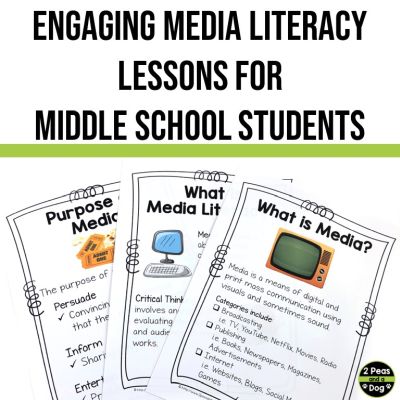
What Is Media Literacy?
Media literacy is the ability to access, understand, analyze, evaluate, and create media messages. It helps people recognize how information is presented, why particular content is published, and how media can influence beliefs, emotions, and decisions.
For students, media literacy involves more than identifying fake news. It includes understanding the difference between facts and opinions, recognizing persuasive techniques, examining possible bias, and considering the context in which a message appears.
For example, a student might encounter a social media post claiming that a particular study method guarantees higher exam scores. Instead of immediately believing or sharing the post, a media-literate student would ask who created the claim, what evidence supports it, whether the research is accurately represented, and what other credible sources report.
These habits encourage students to become active investigators rather than passive recipients of information.
Why Media Literacy Lessons for Students Matter
Young people need reliable information to complete school assignments, participate in discussions, make personal decisions, and understand the world around them. Media literacy provides a foundation for using digital resources responsibly.
1. Students Learn to Identify Misinformation
Misinformation is inaccurate or misleading information that is shared regardless of whether the person sharing it intends to deceive others. Disinformation, by contrast, involves deliberately creating or spreading false or misleading information to deceive or manipulate an audience.
Students who understand these distinctions can better recognize questionable claims and avoid spreading inaccurate content.
Teachers can introduce examples such as an outdated photograph presented as a current event, an exaggerated headline, or a social media post that misrepresents scientific research. Students can investigate what is wrong with each example and explain what evidence would be needed to verify it.
2. Critical Thinking Becomes Stronger
Media literacy encourages learners to examine information instead of accepting it at face value. Students practice asking questions, comparing explanations, identifying assumptions, and distinguishing evidence from speculation.
These skills also support academic performance. When students research an assignment, they can make better decisions about which sources to trust and how to support their arguments.
3. Students Become More Responsible Online
Sharing an unverified claim can create confusion, damage reputations, or contribute to unnecessary fear. Teaching students to pause and verify information before sharing it encourages more responsible online behavior.
Students should understand that they have a role in the information environment. They can help reduce the spread of misleading content by checking claims, correcting mistakes respectfully, and avoiding the redistribution of suspicious posts.
4. Learners Understand Bias and Persuasion
Media messages may be shaped by an author’s viewpoint, a publisher’s goals, advertising interests, or an audience’s expectations. Students need to recognize that a message can contain accurate facts while still presenting an incomplete or one-sided picture.
Classroom discussions can help students examine word choice, missing information, emotional language, and the difference between reporting an event and persuading an audience to support a particular position.
Essential Media Literacy Skills Students Should Develop
Effective media literacy instruction focuses on practical skills students can apply whenever they encounter new information.
Evaluating the Credibility of Sources
Students should learn to examine who created a piece of content, what qualifications or experience the author has, and whether the publisher has a record of reliable reporting.
Teachers can ask learners to investigate the author’s identity, publication date, supporting references, and purpose. Students should also consider whether the author is reporting original research, summarizing another source, expressing an opinion, or promoting a product.
A professional-looking website is not necessarily trustworthy, and a familiar platform does not guarantee that every post is accurate. Students should judge the quality of the evidence rather than relying on appearance or popularity alone.
Distinguishing Facts from Opinions
A fact is a claim that can be checked against evidence. An opinion expresses a judgment, preference, interpretation, or belief. Some statements contain both factual and opinion-based elements.
For example:
- Fact: The school library opens at 8:00 a.m.
- Opinion: The school library is the best place to study.
- Mixed claim: The school library is the best place to study because it provides quiet spaces and access to books.
Students can practice identifying which parts of a statement are verifiable and which parts reflect personal judgment. This skill helps them evaluate articles, advertisements, opinion pieces, and online discussions more carefully.
Checking Evidence and Supporting Claims
Reliable claims should be supported by relevant evidence. Depending on the topic, that evidence might include original documents, published research, official statistics, expert interviews, or direct observations.
Students should examine whether the evidence actually supports the conclusion being presented. A headline may make a broad claim even when the underlying research involves a small sample or a limited set of circumstances.
Teachers can encourage learners to ask:
- What evidence supports this statement?
- Where did the evidence originate?
- Is the information complete and presented in context?
- Does the evidence justify the conclusion?
- What additional information would help verify the claim?
These questions make research more accurate and strengthen students’ ability to write evidence-based arguments.
Recognizing Emotional Manipulation
Misleading content often uses fear, anger, excitement, or outrage to encourage quick reactions. Urgent wording, dramatic images, and claims that something is being hidden can discourage people from checking the facts.
Students should learn to treat strong emotional reactions as a reason to pause and investigate, not as proof that a claim is false. Some important and accurate news is naturally upsetting. The goal is to separate emotional impact from the quality of the evidence.
Understanding Images, Videos, and AI-Generated Content
Images and videos can be edited, taken out of context, or generated using artificial intelligence. A genuine photograph may be paired with an inaccurate caption, while a real video may be presented as if it shows an event from a different time or place.
Students can examine the original source of an image, search for earlier appearances, compare captions, and look for independent reporting about the event. Reverse image search tools may help identify where an image appeared previously.
Visual clues alone are not always sufficient to determine whether content has been manipulated. Students should combine careful observation with source verification and corroborating evidence.
Practical Media Literacy Lessons for Students
Media literacy becomes more meaningful when students practice evaluating realistic examples instead of simply memorizing definitions. The following activities can be adapted for middle school, high school, and other learning environments.
Lesson 1: The Source Credibility Challenge
Objective: Teach students how to assess the reliability of websites, articles, and online posts.
Activity: Provide students with three sources discussing the same topic. One might be a research-based article, another a personal blog, and the third a social media post with limited supporting evidence.
Ask students to investigate each source using the following questions:
- Who created the content?
- What expertise or experience does the author have?
- When was the information published or updated?
- What evidence or references are provided?
- Do independent, reliable sources support the main claim?
Students can record their findings in a comparison chart and explain which sources they would use for a school assignment.
Learning outcome: Students learn that credibility depends on evidence, transparency, expertise, and context rather than website design alone.
Lesson 2: Fact-Checking a Viral Claim
Objective: Help students verify popular claims before accepting or sharing them.
Activity: Present a fictional viral post claiming that a common household activity improves memory by 90 percent. Explain that the statistic is an invented example for classroom practice.
Ask students to identify the main claim, determine what kind of evidence could test it, and search for credible research or expert explanations. They should also check whether the original post links to a study and whether that study supports the stated conclusion.
Students can classify their final findings as supported, contradicted, misleading, or not yet verified.
Learning outcome: Students practice investigating claims instead of relying on repetition, popularity, or confident language.
Lesson 3: Compare Multiple News Reports
Objective: Develop awareness of framing, context, and media bias.
Activity: Select two or three reports about the same public event from established news organizations. Have students compare their headlines, selected facts, quotations, images, and explanations.
Ask them to identify what the reports have in common and what information appears in only one account. Encourage them to consider whether differences result from editorial focus, publication timing, available evidence, or a clear attempt to persuade readers.
Students should avoid assuming that every difference proves bias or that one source must be entirely right while another is entirely wrong.
Learning outcome: Students learn to compare perspectives and investigate missing context before reaching conclusions.
Lesson 4: Investigate an Image or Video
Objective: Teach students to question the context and authenticity of visual media.
Activity: Present an image with a deliberately misleading caption or a fictional scenario in which an old photograph is described as a current event. Ask students to identify the original source, investigate the publication date, and look for other reports featuring the same image.
For video content, students can check the uploader, location, date, original footage, and independent accounts of the event.
Teachers should choose age-appropriate materials and avoid exposing students to disturbing content.
Learning outcome: Students understand that a real image can still be used to communicate a false or misleading message.
Lesson 5: Create a Responsible Social Media Post
Objective: Help students apply media literacy when creating and sharing information.
Activity: Ask students to prepare a short educational post about a school topic, scientific concept, or community issue. Each student must identify reliable supporting evidence, represent that evidence accurately, and distinguish facts from personal opinions.
Before presenting their work, students should review their wording, check numerical claims, confirm image permissions, and ensure that the headline does not exaggerate the findings.
Learning outcome: Students recognize that responsible media creation requires the same attention to accuracy and context as responsible media consumption.
Teaching Students to Use Lateral Reading
Lateral reading is an important fact-checking technique in which readers leave the original webpage and investigate the source and its claims using other websites and independent sources.
Instead of relying only on an article’s own explanation of its credibility, students open additional tabs to research the publisher, author, evidence, and main claim.
For example, if students find an unfamiliar website making a surprising health or science claim, they can search for the organization’s background, look for original research, and compare the claim with information from recognized scientific institutions.
A simple classroom routine can help learners practice this method:
- Identify the claim: Write down the exact statement that needs verification.
- Investigate the source: Find out who published it and what is known about the organization or author.
- Search independently: Look beyond the original page for reliable reporting, research, or primary evidence.
- Compare findings: Determine whether independent sources agree, disagree, or provide important qualifications.
- Reach a careful conclusion: Explain what the evidence supports and what remains uncertain.
Students should document their sources and explain how each one influenced their conclusion. This makes their reasoning visible and gives teachers a clearer way to assess their research skills.
How Students Can Recognize Misleading Headlines
Headlines are often designed to capture attention quickly. Some accurately summarize an article, while others exaggerate the findings, omit important qualifications, or create a false impression.
Teachers can help students recognize several warning signs.
Sensational Language
Words such as “shocking,” “secret,” or “guaranteed” may be used to encourage clicks rather than communicate precise information. Students should read beyond the headline and determine whether the article’s evidence supports its wording.
Missing Context
A headline may highlight one statistic without explaining the sample size, timeframe, comparison group, or limitations. Learners should examine the full article and, when possible, the original report.
Unsupported Certainty
Claims that promise guaranteed outcomes or describe complex issues as completely settled deserve closer inspection. Students should look for the evidence behind such certainty and consider whether the claim overstates what is known.
Misleading Comparisons
A post may compare two figures that were measured differently or use percentages without providing the original numbers. Students should check how the figures were calculated and whether the comparison is fair.
These lessons help students understand that misleading content does not always consist of entirely fabricated information. Sometimes the problem is selective presentation, exaggerated wording, or the removal of important context.
Teaching Media Literacy in Different School Subjects
Media literacy does not need to be taught as a separate subject in every school. Teachers can integrate its core skills into existing lessons.
English and Language Arts
Students can analyze persuasive writing, identify rhetorical techniques, compare opinion pieces with factual reporting, and evaluate the quality of evidence used in arguments.
They can also practice writing balanced summaries that preserve the meaning of an original source without exaggerating its conclusions.
Science
Science teachers can guide students in evaluating research summaries, checking scientific claims, interpreting charts, and distinguishing correlation from causation.
Students should learn to examine how a study was conducted, whether its limitations are explained, and whether other research supports similar conclusions.
Social Studies
Students can compare historical accounts, investigate primary documents, examine the context of public statements, and analyze how different sources portray the same event.
This approach supports historical reasoning and helps learners understand why evidence, perspective, and context matter.
Mathematics
Mathematics lessons provide opportunities to evaluate statistics, percentages, graphs, and numerical claims used in advertising or news reports.
Students can investigate whether a chart uses misleading scales, whether percentages have a clear reference point, and whether the data justify the conclusions being presented.
Digital Citizenship
Digital citizenship lessons can connect media literacy with online privacy, respectful communication, responsible sharing, and the consequences of publishing inaccurate information.
Students can discuss what to do when they encounter a suspicious post, how to correct a mistake, and when to report content through appropriate platform channels.
How Teachers Can Assess Media Literacy Skills
Assessment should measure students’ ability to apply media literacy strategies, not just memorize vocabulary.
Teachers can use short research assignments, group discussions, written reflections, source-comparison charts, and fact-checking exercises.
A practical assessment rubric can consider the following areas:
- Source evaluation: Does the student investigate the author’s credibility and the publisher’s background?
- Evidence analysis: Does the student identify relevant evidence and assess whether it supports the claim?
- Cross-checking: Does the student compare information with independent sources?
- Context and bias: Does the student recognize missing context, persuasive language, or possible bias?
- Reasoning: Does the student explain how the evidence supports the final conclusion?
- Responsible communication: Does the student present findings accurately and acknowledge uncertainty?
Teachers can assess these skills through repeated practice. A student who initially accepts a headline without question may gradually learn to investigate the original evidence and explain why a conclusion is or is not justified.
The goal is not to expect students to identify every false claim immediately. It is to help them develop a consistent, evidence-based process for evaluating information.
Common Challenges in Teaching Media Literacy
Although media literacy is valuable, teachers may face challenges when introducing it into the classroom.
Limited Instructional Time
Teachers already have many curriculum requirements. Short activities can help make media literacy manageable. A five-minute source check at the start of a research assignment can reinforce skills without requiring a separate unit.
Students’ Existing Beliefs
Students may be more willing to accept claims that agree with their existing opinions. Teachers can encourage them to apply the same standards of evidence to all sources, including those that support their preferred viewpoint.
Respectful discussion and open-ended questions can help students reconsider assumptions without feeling personally attacked.
Rapidly Changing Digital Content
New platforms, editing tools, and AI-generated media create additional verification challenges. Instead of teaching students to rely on a fixed list of websites or visual clues, schools should emphasize adaptable habits: checking sources, investigating context, comparing evidence, and acknowledging uncertainty.
Confusing Disagreement With Misinformation
Two credible sources may interpret evidence differently or emphasize different aspects of a complex issue. A disagreement does not automatically mean that one source is deliberately misleading readers.
Students should examine the underlying evidence, distinguish factual disagreements from differences in interpretation, and consider whether additional research is needed.
The Role of Families in Developing Media Literacy
Families can reinforce classroom learning by discussing online information with children in everyday situations. A news headline, a forwarded message, or a popular video can provide an opportunity to ask how the information was verified.
Parents and caregivers can encourage children to pause before sharing surprising claims, check the original source, and consider whether the content leaves out important context.
Adults should also model these habits themselves. A willingness to correct a mistake or change an opinion after reviewing new evidence shows students that critical thinking is an ongoing process rather than a test they must always pass.
When schools and families reinforce the same principles, students have more opportunities to develop responsible information habits.
Building a School Culture That Values Reliable Information
Individual lessons are important, but media literacy becomes more effective when schools consistently value accuracy, evidence, and thoughtful discussion.
School libraries can help students find reliable research materials and learn how to evaluate digital sources. Teachers can require students to explain their source choices in projects, while school leaders can support professional development focused on digital literacy and misinformation.
Schools can also create student-led fact-checking projects, media clubs, research showcases, and classroom campaigns promoting responsible information sharing.
These activities give students opportunities to apply their skills to meaningful questions. They also encourage a learning environment in which asking for evidence is viewed as a strength rather than a challenge to authority.
Conclusion
Helping students develop media literacy is an essential part of preparing them for learning and participation in a digital world. As students encounter an increasing variety of online information, they need practical strategies for evaluating sources, checking evidence, recognizing misleading content, and understanding how media messages influence audiences.
Effective media literacy lessons for students combine direct instruction with regular opportunities to investigate real-world examples. Through source credibility challenges, fact-checking activities, image verification, and cross-subject learning, teachers can help students build habits that extend beyond the classroom.
The ultimate goal is not to make students distrust everything they see online. It is to help them decide what deserves confidence, what requires further investigation, and what should not be shared until it has been verified. By making critical inquiry a routine part of school life, educators can support more informed, independent, and responsible learners.
Leave a Reply